
ZEN environmental competition rebalances climate and biodiversity
Here’s a summary of why
How does ZEN environmental competition work?
To rebalance climate and biodiversity, we need to build a ZEN economy: Zero Emissions Net of greenhouse gases. All its production will be ZEN, with negligible emissions or reduction of natural carbon capture. We must act quickly, as time is against us. (This is detailed in points 1 to 5 below.)
ZEN environmental competition is based on communicating the ZEN impact of every good, service or financial product. This information will allow people to freely choose to buy or finance the most ZEN option for the same amount of money, and it will steer production and finance towards the ZEN economy (points 6 & 7).
We can rebalance the economy in time by implementing ZEN competition and its impacts, by regulating ZEN-toxic financing and production, and by introducing universal climate insurance (points 8 to 10).
After reading the following, explore in more detail how ZEN competition is in the interests of individuals, businesses and public authorities
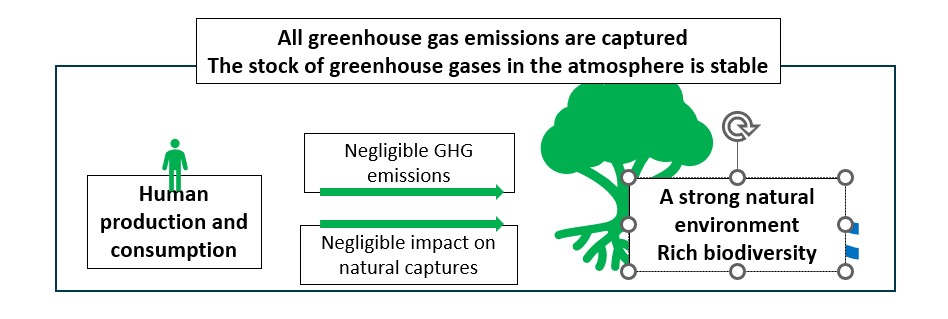
1. Until around 1800, natural ecosystems balanced the greenhouse gas (GHG) levels in the atmosphere
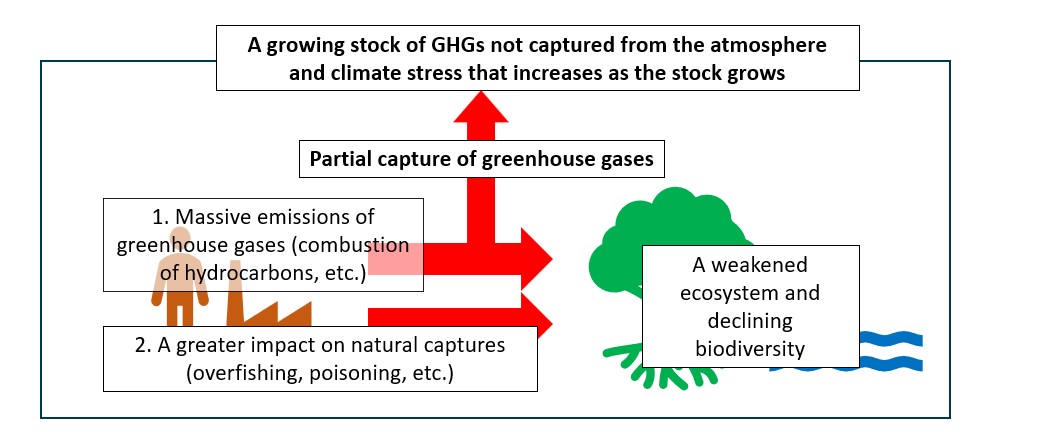
2. Subsequently, human activity has led to a growing and destructive surplus of uncaptured greenhouse gases
3. Time is running out for humanity
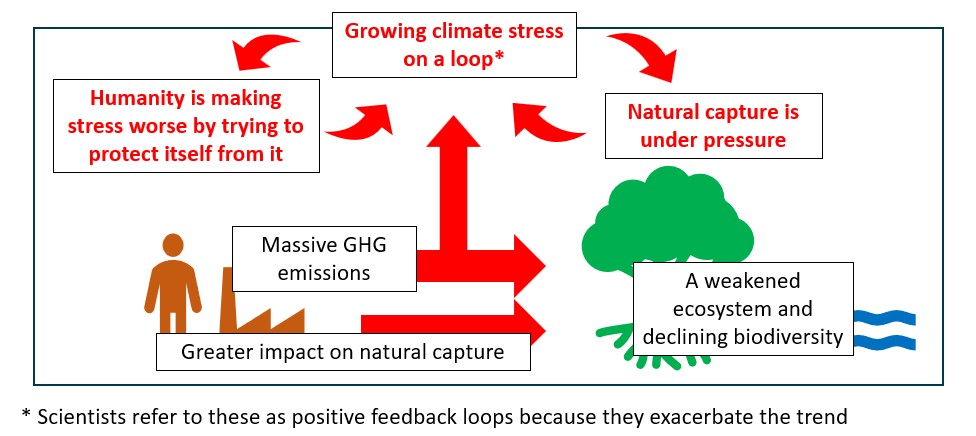
4. The deterioration must be stopped asap…
– A vicious cycle of worsening conditions caused by measures to protect humanity, such as air conditioning

But also : falling crop yields and rising fertiliser prices, rising sea levels and sea defences …
– Declining natural capture : water, heat or chemical stress, ocean acidification due to melting polar ice caps…
Humanity has a limited window of opportunity to halt the rise in greenhouse gas emissions
5. … and therefore achieve Zero Emissions Net (ZEN) in the atmosphere as soon as possible
Restoring balance requires us to produce and consume increasingly ZEN products, so that everyone’s production can quickly achieve :

How can we steer our economic decisions towards more ZEN products and productions ?
6. Environmental competition will drive purchasing and investment towards the ZEN economy
Environmental competition means communicating the ZEN impact to the customer
– for each offer of a good or service
– for each offer of a financial product
-This information allows you to freely choose to buy or finance the most ZEN option, provided the service and price are equivalent
– Production practices and investments the most ZEN are becoming more profitable and better funded : demand drives supply and innovation
Environmental competition is driving the economy towards zero emissions net, without any constraints
Do we know how to quantify the ZEN impact of goods, services and financial products?
7. Measuring the ZEN impact of goods and services sold
The ZEN impact of a good or service is its emissions content* : the emissions required to produce it
A new method provides a simple count based on universal standards**
The same approach yields the other two ZEN impact measures required for environmental competition
– The ZEN impact of a financial product* : the anticipated gain or loss on future goods and services whose production it finances
– The ZEN impact on natural capture *, in addition to the two previous impacts
* View the calculations of the impact of goods and services, financial products and natural captures
** Scientific GHG accounting (national inventories and UN accounting protocols), financial accounting volumes, accounting principles
What should we make of this good news?
8. To the public authorities*…
…to liberalise environmental competition within their territory**
– Encourage companies to count and report the carbon emissions associated with the goods and services they sell, and financial institutions to do the same for the carbon emissions associated with financial products
… to incorporate ZEN impacts into their policies to accelerate the ZEN transition
– With emissions content as a criterion for public procurement, and emissions profitability as a criterion for public investment**, the same level of public spending yields greater ZEN benefits, greater national sovereignty (reduced reliance on fossil fuels) and better health outcomes (avoided poisoning)
– This reasoning extends to other public policies, particularly financial policies : determining the level of credit loss at which financing is deemed toxic and requires regulation
* See ZEN Policy
** See the Label Transmission initiative
9. It is up to the authorities to regulate excessive consumption of emission…
The ZEN indicators will enable us to track progress towards the ZEN target for average per capita consumption, broken down by category : food, leisure, transport…*
To address instances where consumption exceeds actual need, collective rules may specify :
– If a good or service is toxic, based on two criteria: excessive emissions relative to the need in question, and the existence of alternatives that are both cheaper and more ZEN to meet that need.
– A cap on emissions set for producers of toxic offerings (e.g., per leisure day in tourism in the case of excess emissions from leisure air travel).
A minimal, effective, and legitimate constraint:
– The whole community suffers as a result of incidents that could have been avoided
– We avoid contrasting ‘the end of the world’ with ‘the end of the month’
* With a unit of measurement for the satisfaction of a need : in food calories for nutrition, in days for leisure, per digital device for communication…
10. …by extending this competition and climate insurance to the international market
Promoting environmental competition on a global scale is in the national and collective interest
– Countries that do not play by the rules find their exports of toxic products curtailed
– Poor countries lagging behind on the path to ZEN are gaining access to foreign funding, attracted by the potential returns from catching up
But universal climate insurance will also be essential
–Every country is tackling this insurance challenge*, which has arisen :
– Huge inequalities (in terms of exposure to risk and the resources available to deal with it)
– The need to share best practices in prevention
– This national approach is insufficient to address a global risk
Success will depend on the global sharing of risks, and therefore on the transfer of funds between countries
*Everywhere, climate risk is identified as the number one future risk by both the public and experts (AXA Risk Report).